

It is often hard to identify the factors driving Donald Trump one month after the American and Israeli campaign of military action on Iran.
However, it remains apparent he has a keen focus on the oil markets.
A comment – or tweet – from the US president concerning his strategies once would trigger big moves in oil prices, as investors reacted to signals the hostilities could escalate or de-escalate.
However, in the past few days, traders appear to be growing more sceptical about the impact of his comments.
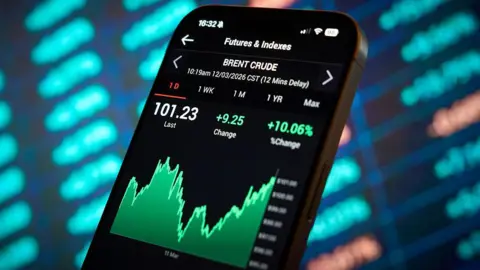
Crude oil was valued at around $72 a barrel (bbl) before 28 February, when the military action against Iran started.
Recently, it climbed to $118 a barrel on 19 March and as of Friday afternoon was valued at just below $112 – significantly higher than its pre-war price.
The following are some moments from the past month where Trump and the financial markets seem to have reacted to one another – with mixed impacts.
Use the arrow to advance to the next slide.
"Energy prices have acted as a barometer for broader political and financial uncertainties, jumping when Trump's language grows aggressive and declining when his language softens," notes one investment manager.
He adds that markets are appropriately reactive to those cues, given the big financial dangers that are associated with climbing oil prices.
"Market participants are trying to assess real risk," he comments. "Markets can look skittish or confused, but what they're actually doing is handling geopolitical risk in real time, with oil positioned directly at the centre of that."
But, it can be challenging for investors to determine how to position themselves, particularly because some of Trump's remarks seem aimed at affecting oil prices, rather than conveying official strategy, says another investment advisor.
"As the saying goes, the first casualty of war is truth," he observes. "It is likely some of the dialogue back-and-forth around successful negotiations, and the opposite, very much are aimed at simply influencing the market price of oil."
Investor Response Grow More Tempered
On a recent Thursday, minutes after US stock markets experienced their largest decline since the outset of the conflict with Iran, Trump announced negotiations with Iran were going "very well" and he was delaying planned attacks on Iran's oil facilities until at least 6 April.
But, the price of crude continued to increase.
One head of FX strategy explains that market reactions are "becoming more muted" because of the "significant disconnect" between Trump's reassurances and the absence of response from Tehran.
"Given the current situation, many investors can not see an quick resolution to the conflict and financial markets continue to be nervous."
Another investment director says markets have also adapted to Trump "frequently changing tack at hints of geopolitical, stock market or financial stress".
"We are seeing a level of scepticism, or even outright suspicion, emerging at the edges," he says.


